
How Charlotte Arrests Enter the County System
Charlotte anchors Mecklenburg County as its seat and biggest city, with 874,579 residents counted in the 2020 Census. CMPD is the consolidated city and county force. It handles most local police work. Even so, CMPD runs no county jail and posts no full chronological booking log. MCSO states that every arrest made anywhere in Mecklenburg County enters through the Arrest Processing Center at 801 E. Fourth Street.
The APC never closes. Staff there log identifying details and charges, take electronic fingerprints, snap the digital booking photo, and run identity checks through FBI and SBI systems. One CMPD street arrest can leave two paper trails. A CMPD incident report goes to the city. A separate MCSO booking entry holds the arrest. Transport, fingerprinting, photo capture, data entry, and review all happen first, so no agency promises a fixed wait before the entry appears online.
Where Charlotte Recent Arrests Appear
Where you look depends on what you need: the booking, current custody, the police narrative, or the outcome. Check official records first. CMPD posts no mugshot gallery or daily arrest blotter.
| Channel | Photo? | Status | Best use |
|---|---|---|---|
| MCSO Arrest Inquiry | May appear on a person result | Official | Booking number, PID, date, charges, bond |
| MCSO Inmate Inquiry | May appear | Official | Current or recent detention status |
| CMPD reports | Not a booking gallery | Official | Originating incident report |
| eCourts Portal | No booking gallery | Official | Hearings and disposition |
| WBTV Mecklenburg | Sometimes editorial media | Independent, selective | Context on reported events |
Private county pages sometimes copy a Charlotte booking under a Mecklenburg or metro label. Those copies can be stale or incomplete. They prove nothing about current custody. No booking photographs are hosted here, so confirm any copied claim against MCSO and the court record.
Steps to Find Someone Arrested in Charlotte
Start with solid identifying details. Name mix-ups happen when several people share a spelling. MCSO Arrest Inquiry accepts a last name, first name, arrest date, PID, or arrest number. The office recommends a name combination or an arrest number, because a broad query can exceed 500 results.
- Open MCSO Arrest Inquiry and search a full name or known arrest number.
- Narrow with the arrest date when the same name returns several records.
- Open the individual result and compare PID, date of birth, arrest date, and arresting agency.
- Read charges and bond as booking fields, not a final court finding.
- Use Inmate Inquiry to ask whether the person is now held in MCDC.
- Check eCourts for later hearings, charge changes, and disposition.
The online inquiry reaches back three years. Older arrest records still exist. Someone released can drop off the current inmate list while the arrest event stays searchable. The Mecklenburg County booking guide covers those custody states in depth.
CMPD Arrest and Incident Records
CMPD's Records Division handles reports its own officers write. Crime reports come through the online report system, at headquarters, or at a division office, per the official records guidance. Copies are free online or in person. Published records hours run Monday through Friday, 8 a.m. to 5 p.m.
Give a date, location, incident number, and record type. CMPD no longer issues local arrest-history reports. It sends those searches to the Clerk of Court at 832 E. Fourth Street. The published search fee is $25, paid by cash, certified check, or money order. That court history does not include a booking photo.
For the county intake record or any releasable booking image, use MCSO Public Information. Its form asks for the person, a date range, and a clear record description. Approval takes three to five business days. No fixed booking-photo fee is posted. Ask about cost when filing. The county photo process is laid out in the Mecklenburg mugshots section.
601 E. Trade Street
Charlotte, NC 28202
General: 704-336-7600
Records Division: 704-336-2848
Viewing the Official CMPD Records Path
The official CMPD Records page maps the city side.
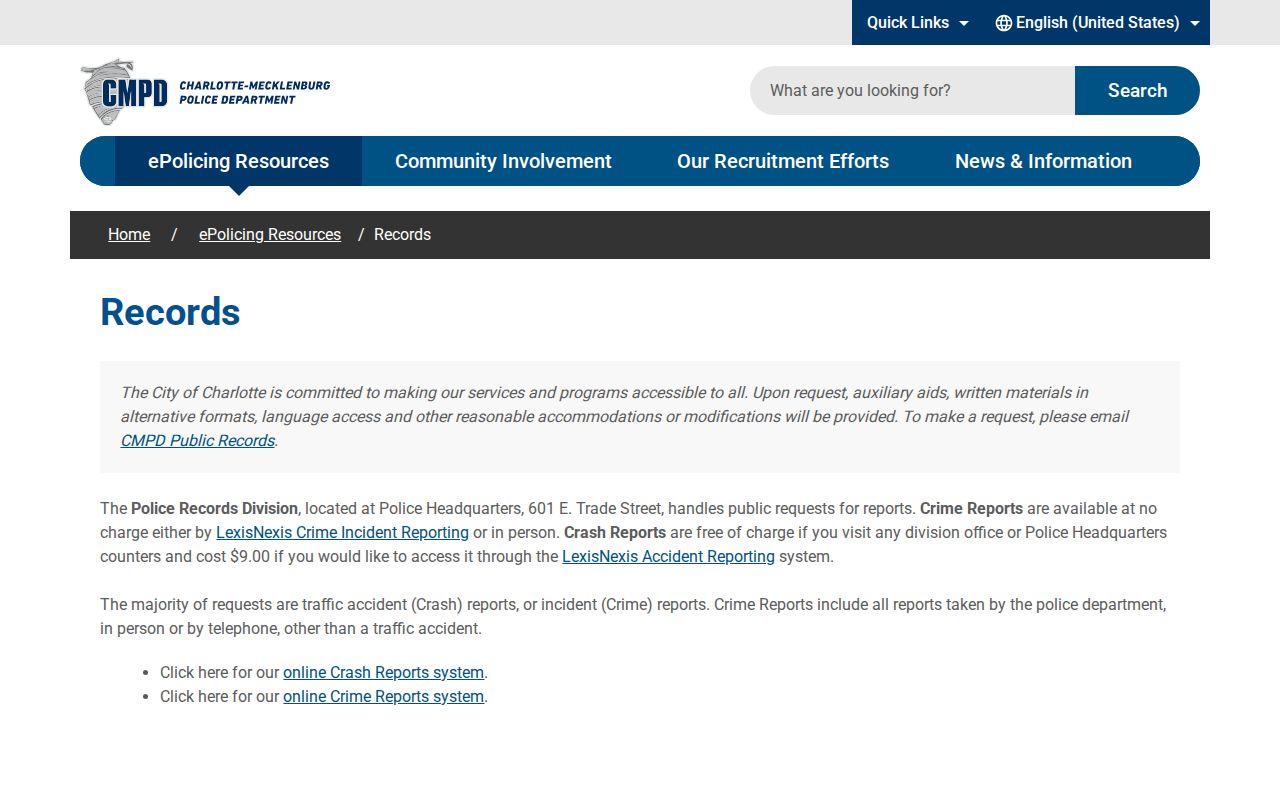
The CMPD page covers the city side of an arrest, while MCSO holds the one booking entry for Mecklenburg County.
Charlotte Arrest Coverage Is Selective
Charlotte newsrooms pick their own spots. The Charlotte Observer Crime & Courts desk, WBTV, WSOC, WCNC, and WCCB each decide which arrests count as a story. Editors judge newsworthiness. That filter shapes everything a reader sees. A news piece can carry more than a booking row ever will. Reporters add police statements, court filings, interviews, and other detail the jail roster leaves out. But the coverage runs on no fixed schedule. It also skips plenty of Charlotte arrests entirely. Read each story with that in mind. Silence from the press is not silence at the jail. A story can sit online long after bond. It can linger past dismissal, or some later turn in the case. A photo in a news article counts as editorial media. That holds unless the outlet labels it a booking image. For the arrest record itself, go back to MCSO. For the case result, go to the court. Aggregator county pages rank last on dependability. Their update timing and correction habits vary widely.
Booking, Custody, and Court Status Differ
One Charlotte arrest can leave a trail of separate records. CMPD owns the street report, since its officers made the stop. The booking record comes from intake at the Arrest Processing Center. Who sits in custody right now appears in the current resident system. Release drops a person from that list. The booking event itself stays put. A sentence into state custody shows up instead through the North Carolina Department of Adult Correction search. It never appears on the county jail roster.
MCSO tags some people with federal, ICE, or other custody labels. Treat those labels as hints. They hint at who holds a person, nothing more. MCSO has said its 287(g) participation ended. Yet later ICE operations and state procedures still matter. Confirm federal custody with the federal system that runs it, and let the court docket settle the legal outcome.
Charlotte Mugshots Are Person-Specific Records
A mugshot in Mecklenburg County is tied to one person's file. It is not part of a browse page. MCSO's public inquiry can show a photo on an eligible person's result. There is no promise of an image for every arrest. No official gallery exists either. Juvenile, protected, investigative, sealed, or expunged material may simply be missing. North Carolina law separates public arrest facts from criminal-investigation records an agency can withhold.
Always read the live government result. It carries PID, arrest number, charge, bond, and custody data that give the photo context. A matching face or name proves nothing on its own. When no photo appears, that does not mean no booking happened. Ask MCSO Public Information about a releasable image. Bring the arrest number or PID if you have it.
Verify a Charlotte Arrest From Three Records
The strongest check on a Charlotte arrest pulls three records side by side. Start with the CMPD report for the city agency's account of the incident. Then open the MCSO booking for intake identifiers, charges entered, bond, and custody. Finally, follow the Mecklenburg court file through hearings to disposition. Each record answers a different question. A mismatch may just be timing rather than a mistake.
Fresh bookings can lag while APC finishes fingerprinting, photo capture, identity review, and entry. MCSO calls its data real-time once entered. No guaranteed posting interval is published, so a very recent arrest may still be missing from the roster. Call Arrest Processing at 980-314-5100. Formal booking requests go to MCSO Public Information at 980-314-5170. Conclusions should rest on official sources. Do not trust an unverified repost.